Foresight for Resilience: The Oman Clean Energy Strategic Outlook

Foresight for Resilience: The Oman Clean Energy Strategic Outlook Lead Author: Dawud Ansari This report examines how Oman’s clean energy economy could evolve under different global futures, and what this means for long-term economic resilience, employment, and industrial development. Drawing on strategic foresight and scenario analysis, it explores how external forces—such as shifting geopolitics, global climate policy, and changing energy markets—interact with domestic priorities. Rather than assuming a single pathway, the report highlights the importance of adaptive policymaking and coordinated national action in navigating uncertainty. Building on this outlook, the study provides a systematic assessment of clean energy–related sectors, identifying where Oman’s strongest opportunities lie and how trade-offs between financial returns, employment creation, and strategic value can be managed. It emphasises integrated industrial ecosystems, dynamic sector portfolios, and regional coordination within the GCC as key enablers of sustainable growth. Designed for policymakers, investors, and experts, the report offers an evidence-based foundation for shaping Oman’s clean energy strategy and labour market in the years ahead. Download
Read More

Developing Clean Energy Industries and Workforce: Case Study Insights

Developing Clean Energy Industries and Workforce: Case Study Insights Lead Editor: Dawud AnsariWith Contributions from: Jacopo Maria Pepe, Abdulkarim Abdulrazek, et al. This report brings international experience into Oman’s clean-economy strategy by examining how other countries have built new energy-related industries—and what helped (or hindered) the creation of sustainable jobs. It is structured as an edited volume of four case studies—Germany’s solar industry, the Netherlands’ wind sector, Saudi Arabia’s EV push, and Morocco’s automotive electrification—each illustrating different sector trajectories, policy choices, and workforce approaches. Drawing these cases together, the report distils practical lessons for Oman on sector selection, the role of government versus private-sector leadership, the importance of ecosystem-based industrial development, and the need to align education and labour policies with industrial strategy. It also highlights the value of vocational training, regulatory flexibility for workforce transitions, and proactive risk management in export-facing sectors—offering a grounded set of insights for policymakers and stakeholders shaping Oman’s clean-energy industries and workforce readiness. Download
Read More

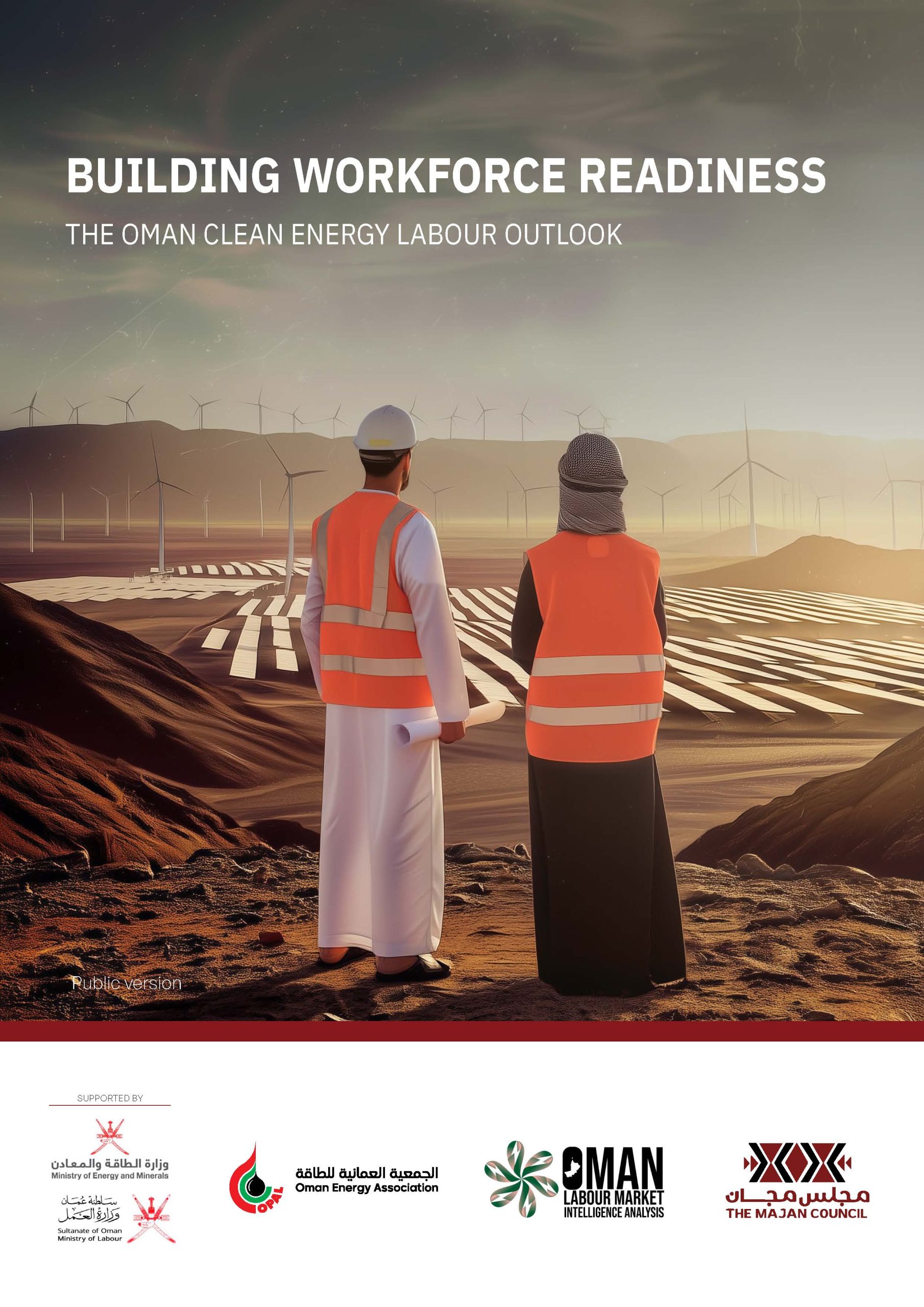
Building Workforce Readiness: The Oman Clean Energy Labour Outlook

Building Workforce Readiness: The Oman Clean Energy Labour Outlook Lead Authors: Abdulrahman Baboraik, Dawud Ansari This report provides Oman’s most comprehensive assessment to date of employment potential and workforce requirements across the clean energy economy. Developed as part of the Oman Labour Market Intelligence Analysis, it examines how jobs may be created across different clean energy sectors under varying policy and market conditions, and what this implies for education systems, labour-market planning, and workforce localisation. Using a bottom-up employment modelling approach combined with international benchmarks and local data, the report offers a forward-looking view of how Oman’s clean economy could translate into meaningful employment opportunities. The analysis goes beyond headline job numbers to examine where jobs emerge along value chains, which skills and qualifications are required, and how employment evolves across project phases. Sector-specific deep dives into solar, wind, hydrogen, building energy efficiency, and clean manufacturing identify skill gaps, localisation challenges, and realistic pathways for upskilling and redeployment. Designed for policymakers, education and training institutions, investors, and industry stakeholders, the report provides an evidence-based foundation for aligning workforce development with Oman’s clean-energy ambitions and long-term economic diversification goals. Download
Read More